Bon Voyage Dorothy!

Will it all fit??
Hmmm, where do I start??? (As I look up and to the left tapping the right side of my cheek with my index finger). I am embarrassed to admit it has been quite a few months since I have updated Dorothy’s blog! But, I must say, I have a good excuse, as Dorothy has kept Matt and I very busy in her new job adventure as a wedding transportation vehicle.
Let me just jump back to March, when we scheduled Dorothy to leave the port of Oakland CA to make the long sea going journey to South Hampton UK. Matt handled the exporting of the bus and started working with a company out of the UK, which put us in touch with Aladdin Shipping in Oakland CA. They were very professional and I would highly recommend them for all your vehicle transport needs.
March the tenth was the day we drove the bus to Aladdin fully loaded with all my worldly possessions. I drove the rental car for the 20 miles over bay and across the Richmond Bridge as Matt followed behind with Dorothy, clearly struggling with her extra weight gain. We made the short journey without incident and with great relief, pulled up outside of the Aladdin offices.
We were greeted by friendly faces, which immediately sensed our growing concerns in leaving the bus to board a big cargo ship, not knowing whether her delicate form would survive the harsh salt weather and the long cruise. To calm our nerves, John, one of the workers, offered to show us the warehouse where they store the vehicles before loading them onto the containers. We both nodded our heads in unison and followed him through a security door and into the huge warehouse filled with cars, trucks and even other VW buses!

Packing Dorothy with my last few belongings from home.
What an incredible operation. We could see the workers systematically loading cars and trucks into the cargo containers. There was one container where they were stacking four vintage cars with nothing but a skeleton of two-by-fours to support their weight on top of each other. I had a moment of panic thinking that was how Dorothy was going to be loaded. But, with the gentle reassurance from John, he convinced me that Dorothy would be tandem with one other vehicle. Whew!
After 30 minutes we finalized the paper work and Matt and I said our good-byes to Dorothy, who was to sit out front as we left her for the next hour until the people at Aladdin were ready to store her for the voyage 4 days later. Like doting parents, we sat outside in the rental car waiting for that hour until she was moved to her safe haven, the warehouse. An hour went by, then another 30 minutes. Then another 30 minutes and still she sat there patiently waiting to be taken in. After two hours, we finally had to just trust in the system and head back….reluctantly, I might add! It was the time we would see Dorothy on US soil.
Dorothy set sail on the Dallas Express on March 17 and was to arrive near London exactly one month later. We tracked her ports of call, starting with Los Angeles, CA then on to The Panama Canal. The ship docked in a port just after going through the canal and then on to North Carolina, where it made another stop. One more stop in Nova Scotia before it headed due east and towards the British shores.

Dorothy parked outside of Aladdin Shipping. The last time we would see her in the US…
While Dorothy was on her cruise, Matt and I dedicated a good portion of our day to promoting the wedding hire business, MoonstruckVW. Our main focus was to get noticed on Facebook by creating a more entertaining page for those VW bus enthusiasts. Posting fun and unusual pictures of things bus related stirred up quite a buzz and soon we were having inquiries for Dorothy. One of the frustrating things about doing wedding hire is, as a transport business, we can only do weddings and funerals (believe it or not!). So, it was a huge let down when the messages and phone calls started to come in only to request a price on proms! It was getting to the point where we just didn’t want to answer the phone anymore only to be foiled again by another prom inquiry!
Finally, people started to get the message when we changed our Web page by specifically stating our limitations. This was the turning point for us. Wedding related date requests started to pour in, and the prom seekers slowly diminished.
One of the other life changes we needed to make was to find a house that could adequately store Dorothy from England’s moist weather.

The Dallas Express, the ship that brought Dorothy to the UK.
The prelude to shipping Dorothy:
We cruised the web for several months in search of the perfect house for Matt, his youngest son, Sean and me. Something that was big enough for the three of us, my two cats I had shipped from the US and garage big enough to house Dorothy and our two motorbikes. This would not be as big of a problem if we were doing this in the states, but here in England, garages are few and far between, especially two car garages.
Finally, in early February of 2014, I spotted a house in a little village outside of Stafford. The pictures looked really good, but looks can be deceiving when it comes to selling something on the internet. We took a ride to take a look and it was perfect for what we needed. A quaint, but larger house with a sizable English garden front and back and a two car garage! We had not gone back to the US as this time to ship Dorothy back to the UK, so we had no way to know if Dorothy would actually fit or not, but we were confident she would—-she would have to because the house was perfect and time was running out!

Dorothy all dressed up in her wedding attire in the UK!
Dorothy’s blog in chronological order:
Dorothy’s blog in chronological order:
The plight of a little 1970 Volkswagen bus known as Dorothy – Page 1
https://motoette.wordpress.com/2013/09/16/the-plight-of-a-little-1970-volkswagen-bus-known-as-dorothy/
The plight of a little 1970 Volkswagen bus known as Dorothy–Page 2
https://motoette.wordpress.com/2013/09/20/the-plight-of-a-little-1970-volkswagen-bus-known-as-dorothy-page-2/
The Plight of a Little Volkswagen Bus Known as Dorothy — Page 3
https://motoette.wordpress.com/2013/09/27/the-plight-of-a-little-volkswagen-bus-known-as-dorothy-page-3/
Day 1 – Dorothy’s Blog – A One Way Ticket to Wichita.
https://motoette.wordpress.com/2013/09/29/day-1-dorothys-blog-a-one-way-ticket-to-wichita/
Day 2 – Dorothy Takes to the Open Road
https://motoette.wordpress.com/2013/09/30/day-2-dorothy-takes-to-the-open-road/
Day 3 – Is This The Way To Amarillo?
https://motoette.wordpress.com/2013/10/01/day-3-is-this-the-way-to-amarillo/
Day 4 – Albuquerque and the Watermelon Mountains
https://motoette.wordpress.com/2013/10/03/day-4-albuquerque-and-the-watermelon-mountains/
Day 5 – Dorothy Has a Drinking Problem
https://motoette.wordpress.com/2013/10/03/day-5-dorothy-has-a-drinking-problem/
Day 6 – Four Corners and Almost 7 Days Ago
https://motoette.wordpress.com/2013/10/04/day-6-four-corners-and-almost-7-days-ago/
Day 7 – Dorothy Has a Thing for the Beatles
https://motoette.wordpress.com/2013/10/06/day-7-dorothy-has-a-thing-for-the-beatles/
Day 8 – Turning Another Page
https://motoette.wordpress.com/2013/10/07/day-8-turning-another-page/
Day 9 – Look, But Don’t Touch!
https://motoette.wordpress.com/2013/10/08/day-9-look-but-dont-touch/
Day 10 & 11 – Viva Las Vegas!
https://motoette.wordpress.com/2013/10/10/day-10-11-viva-las-vegas/
Day 12 – What a difference a State Makes
https://motoette.wordpress.com/2013/10/10/day-12-what-a-difference-a-state-makes/
Day 13 & 14 – There’s No Place Like Home, There’s No Place Like Home
https://motoette.wordpress.com/2013/10/13/day-13-14-theres-no-place-like-home-theres-no-place-like-home/
Dorothy – As Days Go By
https://motoette.wordpress.com/2013/12/03/dorothy-as-days-go-by/
Bon Voyage Dorothy
Dorothy as Days Go By

Dorothy all dressed and ready to do to work!
Where does the time go while you’re having fun? I can’t believe it’s been 6 weeks since Matt and I took our epic journey back to Kansas to pick up Dorothy and drive her almost 2,5oo miles back to California– and get married in Vegas on the way! Well, even though it seems like yesterday, Matt and I have done well with our time and have managed to kick some Fahrvergnügen butt and accomplish some impressive goals, at least to us! If you’re diggin’ the scene, then read on my brotha’s and sista’s to find out ……To start:
After three mechanics, two carburetors, one distributor. one float valve and a major brake job, still, the beat goes on! I have another appointment to bring Dorothy to her latest mechanic, Paul to have her exhaust worked on. This will alleviate two problems, one; the low power in low revs problem and two; it will fix the interior heater, which currently is not hooked up because of carbon monoxide fumes it emits into the cabin, making it difficult to drive when you’ve kicked the bucket!. *cough, cough, gag!*
Paul owns Valley Wagon Works, here in San Rafael, I was actually referred to him by a friendly worker at Homedepot. Wagon Works only does Volkswagen busses, nothing else, so that was a really good sign. Matt and I were quickly becoming discouraged in our discovery that there were not a lot of mechanics who know all the in’s and out’s of an air-cooled engine.

Floor before I refinished

Floor after I refinished
We had learned that a really good vintage VW mechanic was a rare find and even more rare the further east you go. This would explain why Dorothy had some rather unusual idiosyncrasies. For instance, her stick shift is way over to the right, making it difficult to find the gears. Matt and I were forever searching for all four of her gears while on our journey back to California. It turns out, her gear plates are in backwards! An easy mistake, if you don’t know what you are doing. Her steering is not set right, the light switch that is triggered by the doors was completely wired backwards (among other things), which is why it didn’t work. She has a new engine, but it’s a 1971 engine and Dorothy is a 1970. These are not big deal items, but just humorous as we learn more and more about her and how she was maintained.

Before I repaired the dashboard

After I repaired the dashboard
What Matt & I have done so far:
Rather than spend $600 plus to replace the water stained door panels, we decided we could do a much better job and it would be more durable and tasteful than the standard option of cheap vinyl on cardboard. Matt cut, shaped and glued the fabric on to each of the 7 panels while I frantically sewed the fabric that was to cover them. We picked out a rich taupe ultra suede for the top and a chocolate-brown vinyl for the base of the panels. I put ruche pockets on three of the panels, which was rather challenging with my limited sewing ability!
I have to say, we really did a nice job in how they turned out. Matt trimmed each panel in a chrome trim with matching screw covers that really set it off. We have replaced: two front indicator seals and the two bulbs, two side reflectors, one chrome head light ring and the two rubber door steps on the front bumper. Added an engine seal, replaced driver’s door seal. New glove compartment, new leather steering wheel cover, installed the rubber trim around the pop up that was missing, fixed the doors locks, W-D’d everything! Spray painted just under the ignition where the keys scratched the matte black paint away. Repaired the dash with a vinyl repair kit. Sanded, then sanded again and varathaned the parquet floors.
Matt spent two days under Dorothy wire brushing any surface rust and then painted her underbelly with rust inhibiting paint. Matt also wax oiled all the inside panels to keep rust from developing. He went around the bus and touch-up painted anything that even resembled rust! I took the grill off and cleaned and painted the inside. Squirted the vent mechanism with W-D while I was in there, now the air vent opens and shuts completely now.

 I made new curtains for all the windows and installed the curtain wire that was missing. I could literally stand the old ones up they were so old and stiff! I made matching bolsters for the seat in the back. Replaced the old gas fireplace with a new electric one, so cute! Sanded and cleaned the two aluminum louver windows. Removed the decorative chrome head lamp covers and then scrubbed the rust off the glass of the head lamp it had left. We could not understand the function of these covers, since all they did was reduce the intensity of the beam of light in which to see at night! Whatever!
We washed and waxed Dorothy and polished her Porsche chrome wheels. We have cleaned under and over everything inside and out and managed to cure most of the squeaks that she had accumulated from her aged body!
What still needs to be done:
Her exhaust and a new ignition. I would also like to have all her spark plugs changed. Steering, gears are a must and that should pretty much cover it for the time being.
Because she will be shipped to England, she needs to pass the MOT. A mandatory annual inspection that is required in order to be able to drive your vehicle legally on UK roads. This means, replacing the rear lights and installing independent amber indicators from the brake and rear lights. The heater needs to work in order to get air flow to the windscreen in dealing with condensation. The windshield wipers need to operate properly as well as the windshield washer, which doesn’t work at all. We are still dealing with solving rust issues and poor Dorothy has an unsubstantiated amount of orifices for water and moisture to find their way in and therefore, creating RUST! So, this is an never-ending challenge for us, but one we happily take on!
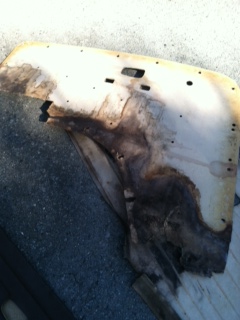
Inside of the old door panel Yuk!

Matt works his magic in creating new panels
What’s next:
Matt has been creating Dorothy’s Website http://www.moonstruckvw.co.uk/ together we both have been adding content and pictures. It is still a work in progress, but at least we have something up and running, next we will be adding a Facebook page. Okay, so I admit, it’s a small set back having Dorothy still in the US and the business in the UK, but we’re working on it! Our goal is to have everything setup and ready to go, with Dorothy and with the advertising. We are scheduled to have our first official gig in May chauffeuring our good friends son and his bride-to-be to their wedding. We are really hoping that Dorothy can be a part of this very special day.
Our projected time to ship Dorothy is the end of February, which will roughly bring her into a UK port at the end of March, just in time for the kick-off of the wedding season. If the there is an abundance of interest beforehand, then we will have to rethink the shipping date. We are waiting to ship for a few months to avoid additional fees, but if there is money to be made, it only makes sense to send her on and we’ll make up the added costs in revenue. It’s a no brainer!

New door panels and steering cover

Closer look

A ruched pocket behind the passenger seat. This is where the new fireplace will go.
.
It’s a Family Affair – Dorothy’s New Home in California

A picture paints a thousand words!
It’s been an interesting 2 weeks since our triumphant trip, traveling almost 2,500 miles from Wichita Kansas to San Francisco California in a 1970 Volkswagen bus named Dorothy.
Just two days after we arrived, we took Dorothy to a small VW gathering called the Deutschland Dubs 2nd Annual Air-Cooled Roundup Picnic at the Presidio just over the Golden Gate Bridge in San Francisco. The picnic was to be held at Crissy Field, but again, being tormented by the National Park closures, the organizers had to relocate the small group.
We were very excited to be able to attend and hang out with other dedicated Volkswagen owners just weeks after purchasing her. We were also a little hesitant to go because Dorothy had not been running well. she was stalling anytime we would apply the brakes to stop in the last few hundred miles of our trip.

Bus gathering overlooking the SF bay
In the end, it was taking both of us to drive her. One person to keep their foot on the brake and one person to keep their foot on the gas so she wouldn’t die. It was really becoming tiring and concerning. She also didn’t sound good, her idling point would constantly vary, so anytime Matt tried to adjust the idle it would soon change. Clearly, it was time to give Mike (my mechanic) a call.
Regardless, we went ahead and took Dorothy to the meet up. It was a rare clear, glorious sunny day in the famous foggy city. We pulled into the parking area at the Main Post where twenty to twenty-five other Volkswagens were parked. We saw a bunch of bugs and several bay buses with three splittys. Two of the bays looked just like Dorothy. Almost immediately Kim and Bob came over to Matt and I to say hi and ask about Dorothy. We explained to the nice couple from Sacramento about how we acquired Dorothy and our recent epic adventures driving half way across the country. They loved the story and then digressed into their personal “bus “ story when we asked about the history of what looked to be the brother to Dorothy.

Kim’s bus as she found it at the wrecking yard.
Kim literally rescued “Wes” within hours of being dismantled for parts in a wrecking yard two years ago. Kim knew she had been given a rare opportunity and spent these last few years rebuilding the engine, replacing parts and injecting some good ole elbow grease to clean him up! Matt and I were very impressed and happy to say Kim is now a fellow VW compatriot on earlybay.com and a Facebook friend.
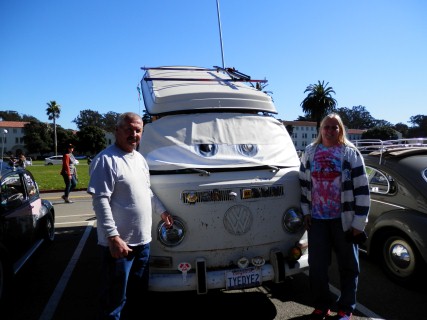
Kim, Bob and Wes
We parked Dorothy next to an early sixties single cab splitty owned by Lloyd and Diana from San Jose. Not long into a friendly conversation, Lloyd told us he found his prized rustic relic from a convicted ax murder, who apparently liked to collect vintage Volkswagen’s when he wasn’t hacking people up! Obviously we thought Lloyd was joking, but unfortunately (for his victims) he wasn’t!

Lloyd and Diana from San Jose
I loved what Lloyd did with the single cab, by giving it a “rat” look, which is the new term used to describe retaining the original rustic patina that is becoming so popular with vintage bus owners. The unique feature to this single cab, was he had retro fitted utility bars on the flat-bed that included a retractable awning, a removable table off the tailgate complete with a mini Weber and a Tepui tent folded neatly in its own case on top next to the sun deck. I was thoroughly impressed with his creativity!
Matt and I really enjoyed talking with the cute couple and was sorry when they finally had to leave after having a full weekend of camping. Hopefully, our VW’s will bring us together again sometime in the near future!

Lloyd and Diana’s cool single cab creation!
As the morning progressed into the afternoon, we met more interesting Volkswagen owners like Jason who owns a 1973 convertible bug. He had done quite a bit of work to the engine, which was very impressive considering our current situation with Dorothy. I noticed a Hawaii license plate attached to the bumper, something owners do to indicate where the vehicle originated from. So, of course I asked the obvious question thinking I would get the obvious answer “oh, so you brought this bug all the way back from Hawaii?” His reply (to my surprise) “no, I’ve just been there 23 times!” Another new Facebook friend!
Kyle, another bug owner (and Facebook friend) apparently had one of the original “Herbie” cars from the famous 1960’s Disney movie. This bug was immaculate and amazing in its preservation. The glossy cream bug with the off-centered red, white and blue stripe was definitely in its element with a backdrop of San Francisco and parked in the same vicinity as the Disney Museum, founded by Walt Disney’s daughter exactly four years ago this month.

Kyle’s “Herbie”
One of the last bus owners we talked with that had another interesting story was a guy who had purchased a 21 window splitty sight unseen from Colorado about nine months ago. He told us he found this bus on eBay. The seller was a widow trying to sell her husbands bus which mainly sat in a garage for most of the years he owned it. Looking at it, I could see it was in really good shape, but that there were little things that needed doing.
He went on to tell the story about how he bought it. How he sat there for what seemed like hours, holding his finger over the “ buy it now” sign, contemplating whether or not to pay the thirty thousand plus sales price. He said he kept asking his girlfriend if he should do it? Her boisterous reply was “just do it!” So he finally did….seconds later, to his disappointment the screen displayed “ bidding closed for this item”. He was crushed!

Splitty bought on Ebay from Colorado
He continued on, explaining to us how a light bulb went off in his head several minutes later to send the seller an email in his new-found overwhelming desire to buy the vintage bus, just in case the bus came up on auction again. Within a few hours he heard back from the seller, informing him that indeed the original bidder couldn’t come up with the money and the bus was up for sale again. Needless to say, the rest is history!
Matt and I enjoyed the rest of the afternoon sitting next to Dorothy in our red folding chairs basking in the autumn sun talking to people who passed by us. Our good friend Jan rode up on his BMW motorcycle to check out the action and to visit some of his VW friends. Jan has been an avid VW collector and fan, owning two rare models. A late fifties split window barn door bus and a split window bug, along with a small fleet of other Volkswagens in his drive. It was great to see him – Jan gave us a lot of information about Dorothy’s engine while all three of us sat at her back side, taking inventory of all her parts!

Matt, Jan and me
At three-o’clock we pulled out and headed home, extremely pleased with the events of our day. We met some great VW friends that will continue on with the aid of Facebook and gained valuable input from seasoned owners with our moonstruck goal to revitalize and maintain these delicate metal creatures.
I guess a person could be wooed by worse…like a Studebaker or an Edsel!

Day 13 & 14 – There’s No Place Like Home, There’s No Place Like Home

We left Tehachapi at around 11:00 AM, our next target point was Monterey, CA to have a quick over night visit with my 99 year-old grandmother. She still lives alone (I know, scary thought!) and is always up for some last-minute company.
Descending down the 4,000 ft drop from Tehachapi, we drove through hills that looked strangely like a huddled sleeping litter of tan sharpei puppies. Soon after, we leveled out into Bakersfield, a large farming town with (to my surprise) wineries popping up here and there along the long and arduous hwy 58. I had always heard Bakersfield was not the prettiest of towns and I have to agree. It had an industrial influence with clusters of unattractive suburbs surrounded by a lot of dry, dead, brown weeds!

We pushed on traveling hwy 99 for a short distance and then redirected Dorothy west, onto interstate 46, which would connect us to hwy 101 eighty miles later. If you have never had the pleasure of visiting the southeast portion of the golden state of California, I can tell you as a native of northern California, you will know you have crossed the state-line by the bad, beat-up roads, high gas prices, ugly inland terrain and aggressive rude drivers! It was seriously the most uninviting state we had been through until we reached Monterey.
We arrived at my grandmother’s at just after 5 PM and had a short visit before going out for dinner. We had to get my grandmother’s petite, five-foot-nothing frame in the front seat of the bus, which was quite a picture! She couldn’t get over why we bought such an old vehicle and kept asking the question “why is it squeaking so much?” Matt and I just laughed not knowing exactly how to answer such an obvious question.
 We had a nice visit, Matt fixed a few items for her, we spent the night and we’re gone by 9 AM the next morning, our fourteenth and final day.
We took off under typical coastal overcast skies heading north on hwy 1 before connecting back onto hwy 101 for the crowning 160 miles to San Francisco. It was no doubt a rewarding feeling for both Matt and I, but at the same time, a very sad moment knowing the next few miles was to be the conclusion to an epic and life changing journey.
We crossed the Golden Gate Bridge at lunch time and decided we needed to have a picture of Dorothy with the famous landmark, so we drove her down to Fort Baker a the base on the Marin side of the bridge. We posed Dorothy just right with the massive brick-red spanning arch behind. Before we could take our long-awaited photo’s we had a group of Chinese tourists come up to ask if they could have their picture taken with Dorothy. Matt politely obliged and accepted their camera for the unique photo opportunity.
 Matt no sooner finished and a group from Holland approached us asking all about Dorothy. He explained happily one more time knowing it would probably be our last while still on our trip.
Twenty minutes later, after we managed to get our own pictures of Dorothy, we jump back in and made the short decline down into the picturesque town of Sausalito. Sausalito is perched right on the bay and the first town just after crossing the Golden Gate Bridge, a place I know very well from growing in Mill Valley, which resides just next door. It’s an area that is very foreign to me now because of wealthy people moving in and an over abundance of tourists visiting all year-long. Remarkably, both towns used to be total hippy hangouts, so driving through with a 1970 VW bus was apropos. It’s just too bad no body would get it!
We stopped at a little Italian place for a quick bite just outside of the harbor town that Matt and I frequently go to when passing through. A mile down the road we voted to make a surprise visit to my sister, Barbra while she was at work to show her and her co-worker Eva the famous Dorothy.

They both couldn’t stop giggling over her and what we had just accomplished over the past two-weeks. For my sister, seeing the bus really took her back in time to our dad’s VW bus growing up. She kept repeating the words “ It’s so small inside, I remember it being so much bigger!” Clearly reenforcing that everything looks bigger when you’re a child!
We talked her into taking Dorothy for a spin around the yacht harbor she works at. She excitedly hopped in and started Dorothy up. Putting some muscle into it, Barbi turned the 18 inch steering wheel navigating her slowly around the parking lot and harbor, waving and honking that distinct Volkswagen honk as she passed everyone she recognized. She couldn’t get over how difficult Dorothy was to drive, which (I think) gave her a more real understanding of what we went through in transporting the bus such a long way.
Soon after our little cruise through the parking lot, we said our good-byes to make the last 5 miles to San Rafael. Pulling in the drive, Matt and I both looked at each other and without a word we both embraced, silently comprehending and appreciating our great accomplishments over the past fortnight.

Two weeks, 8 states, 130 gallons of fuel. 4 fuel additives, 1 litre of oil, 1 litre of brake fluid, 1 fuel filter, 1 set of points, two visits to the garage, 2,468 miles, a wedding and an incomprehensible amount of messing with her backside and we made it!
We know that Dorothy couldn’t have made it without the love and support of family and friends to encourage her along the long path back to California.
Matt and I would like to personally thank Dave, the previous owner for being a wonderful guide and mentor throughout our trip by text and/or email to help us pilot Dorothy to her destination. His last text to us upon arriving in San Francisco, “I am frigin’ crying! I love it and so proud of both you crazy people! Drive on!!”
Also to Pete and India in Albuquerque, NM for treating us to a delicious dinner, a cozy and beautiful place to crash out and Pete’s help to get the ailing Dorothy back on the road! Love you both! Everyone on Facebook, family on Viber and comments on the blog, your words of positive encouragement were overwhelming and so amazing in helping us to keep the faith to make our goal. Thank you from the bottom of our (and Dorothy’s) hearts!
Love.
Matt, Cindi and of course, Dorothy!
Day 12 – What a difference a State Makes

It was a great two days in Las Vegas, mainly because it played a huge important role in my future with Matt. But, I’m not a gambler, I have an aversion to large crowds of people making fashion faux pas’ and paying way too much for, well, EVERYTHING! We were both ready to move on and deal with Dorothy’s “moods” once again.
Under clouded skies, we departed Las Vegas heading south on I-15, one-hundred and fifty-two miles from our next target point in Barstow, California. As I had mentioned on several occasions, we had been blessed with exceptional weather, waking up to glorious sunny skies accompanied by mild autumn temperatures. We were seriously spoiled!
The good luck with the weather, was more important for safety in transporting Dorothy, than for us. Bad weather could mean impending danger for both Matt and I.

Less than fifty miles on the road and we crossed the California state line and into the Mojave Desert National Park region. Beautiful beige desert land scattered with a variety of indigenous cactus plants with a backdrop of the Nopah and Providence mountain ranges, encircling the arid foreground.
With each mile we drove, the merciless desert winds grew with intensity. We passed a sign flashing a “high wind” warning sign enforcing what we already knew.
I always thought of a Volkswagen bus as kind of a big vehicle, but parking next to trucks and mini vans, I could see by comparison, that the VW bus is quite petite. The tall, blunt, square shape of Dorothy just made any type of aerodynamics null and void and with the combination of wind, the vague steering control and four narrow tires, we were continually fighting to keep her in our lane.

Semi trucks and big rigs became our enemy soon into our journey, especially when gusty winds were present. Dorothy just did not have the capacity to keep up with the monstrous trucks and so that meant we were always being passed by them. I would see them coming up in the rear view and would prepare myself for the violent shift in wind as they would pass. The worst part was when they would pull back into the slow lane, which would create a vortex of air that would make Dorothy shiver, shimmy and shake. This was an on going occurrence throughout our day trips, which meant more intense concentration in controlling her. It was a very unnerving and an exhausting process!
We did find entertainment driving the mundane straight road by listening to music and having an intermittent laugh by the honks and waves of passing motorists responding to our “just married” sign hanging in the back window of the bus!

The topography continued to morph into flat volcanic desert sands with the most interesting array of Joshua trees, It seemed the further we went the bigger they got and then with a blink of an eye, they were gone!
We pulled into a gas station in Baker, CA to take a much-needed break and refuel Dorothy. The minute I pulled into the Chevron station this middle-aged man pulled up in a Cal Trans truck with a grin from ear to ear. It was also starting to rain, so Matt was at the front of the bus applying RainX to compensate for Dorothy’s slow and incompetent windscreen wipers. The Cal Trans guy, laughing as he spoke started to tell Matt and I about his 1968 automatic VW bus, repeating the words “ I loved that ole girl!” several times in our dialog. He explained that he had her for 12 years and finally gave her up to a neighbor’s daughter for $500 after it had been sitting in his drive with a blown engine. I said to Matt later, that I actually thought the guy was going to cry after seeing us with Dorothy.
Again, reconfirming how much deep untapped emotion a VW bus can bring out in the lives of people they touch. I can’t tell you how incredible it feels to be able to bring out those fond emotions.

Once we reached Barstow, we decided to keep going despite the increasing bad weather. It had now gone from wind, to wind and rain and you know how much Dorothy loves the wet!
She carried us on and at one point in Mojave we could see ahead we were heading for the biggest black cloud we had seen in a long time! Our goal to make it another 60 miles to Bakersfield was probably not going to happen. We babied Dorothy up another hill and down into a small town in Tehachapi, CA. It was wet, it was getting dark and it was unbelievably cold! We could actually see snow on the hill tops!
Dorothy got us there and she was done!
We pulled into a La Quinta motel and got a room. The young girl at the front desk could see Matt adjusting the idle again just outside the front glass doors. She asked me what he was doing? When I explained the differences from a modern-day car to a 43-year-old car, she was amazed at what I told her. That with a seventies car, especially a VW, you don’t just jump in and drive it!
I think Dorothy, in her moment of sheer exhaustion, still managed to entertain yet another onlooker!
Day 10 & 11 – Viva Las Vegas!

I hope you don’t mind, but I decided to combine days 10 & 11 together for….well, obvious reasons! Matt and I got hitched!
We broke camp and left the picturesque town of Virgin early Monday morning, opting to skip breakfast and power on through for about an hour. We wanted to arrive in Vegas no later than 3:00 PM so we could check-in at the Mandalay Bay hotel and relax by the pool of a while before attending the Cirque du Soleil show called Love later that evening.
Frustrated and hungry, we pulled off I-15 at St George, Arizona to find a quick place to eat and deal with Dorothy and why she insisted on stalling every time we came to a stop. Pulling into a random parking lot after having no luck finding food, we noticed a pick-up truck come up beside us. We watched as this 40 something guy got our of his truck and with smile on his face came up to Dorothy’s driver side, where Matt was standing.

The first words out of his mouth was “I have four of these!” Matt explained to the fellow stranger about Dorothy’s idling problem and proceeded to the rear engine compartment. The friendly stranger was somewhat helpful, but of course had to tell us his VW bus stories accompanied by pictures. This was definitely becoming a daily routine on our journey and we loved it!
We carried on south, down I-15 after finally finding some much-needed nourishment. We passed up and over another dramatic mountain range coming out of Arizona and into the desert sands of Nevada.
It was strange coming into Vegas, because we had spent the last week and half driving on one or two lane highways connected by relatively small towns. It was more intimidating than I expected and people were surprisingly rude and impatient to Dorothy’s slow speeds and even slower starts from a full stop. We got attention, but not in the positive way we had been used to. I suddenly couldn’t wait to get out of Vegas and we had just arrived!
The other side of the coin was we needed a break from Dorothy. On a daily basis, she is a lot of work to drive. She can’t take high-speed, high winds, and tight corners, or even a slight bend for that matter! She is very sensitive, she doesn’t like cold, she doesn’t like hot, she doesn’t like wet, she’s hungry all the time and she goes (and stops) when SHE wants to! She is easy to hot wire, easy to steal and therefore, we have to babysit her all the time! Who needs kids (or grand kids) when you have Dorothy! We were looking forward to having her sit in the hotel garage for two days while we rested from her demanding personality!

We checked-in to our beautiful suite on the 14th floor with an amazing view of the strip. We spent our first day just wandering around the casino and showing Matt a little bit of Tinsel Town on his maiden visit. During the two-day visit and no Dorothy, we found ourselves going to a Beatles Show (Dorothy’s favorite group) playing the slots on a “Wizard of Oz” gambling machine and bringing her name up every hour on the hour! I think the bright lights finally got to us…or was it Dorothy?
On October 8 at 6 PM Matt and I had an intimate ceremony at the Little Church of the West and exchanged our eternal vows of love to each other. It was crazy, it was spontaneous and it was perfect! We hired a Town car to pick us up a the hotel and escort us to the historic church and back in time for a very romantic dinner to celebrate. We both couldn’t be happier and we thank our friends and family for their love and support in our decision. We love you all!

Day 9 – Look, But Don’t Touch!
 We woke up to another brilliant sunny day, the temperatures were noticeably back on the rise, which meant we could put our shorts on! Still feeling a little disappointed from the day before in our choice to drive all the way out to Page, Matt and I decided to take advantage of the complementary breakfast at the hotel, in order to make our quick exit out-of-town.
The confining eating area was filled with lodgers, who most likely had the same plan as us, because it was standing room only at the Corn Flakes counter! This actually gave Matt an opportunity to start chit chatting with two couples from Kent, England, who had also been left to rethink their travel plans due to the government shut-down. They enlightened us on a few scenic viewing points we could go to in order to not make our trip a total loss.

On our way to the recommended viewing sites, we passed a do-it-yourself car wash and decided Dorothy needed a bath. Matt lathered her with bubble gum pink suds in an effort to remove the accumulated road debris from her pug face and wide girth (don’t tell her I said that!). It was a two-person job to clean her up, but twenty minutes later she was a sparkling beauty! Matt went to start her up and she wasn’t turning over. We both looked at each other with the same expression of “uh oh”. Four or five clicks of the ignition and were now really getting concerned. It was clear, Dorothy did not like having a bath.
Finally, Matt was able to turn over the engine, I kept my foot on the accelerator while he went back to her hind quarters to douse her contacts with WD-40, which we think got wet from the intensity from the sprayer.
Wiping another bead of sweat off our brow we putt, putted down to the viewing area to find a car park full of tourists. The minute we pulled up we were accosted by at least 10-12 people all wanting to know about Dorothy. There was a couple in particular from Michigan who asked if they could have their picture taken in front of the bus. Matt offered the option of sitting in the bus, but they were happy to stand by Dorothy, explaining that the picture was for an ongoing family joke.

Another woman we talked to from Australia reminisced about how she rode Route 66 back in the 70”s in a VW bus with a group of stoned hippies. Seeing the glow on her face as she relived the story, I could tell she was enjoying the fond memory. It was very cool!
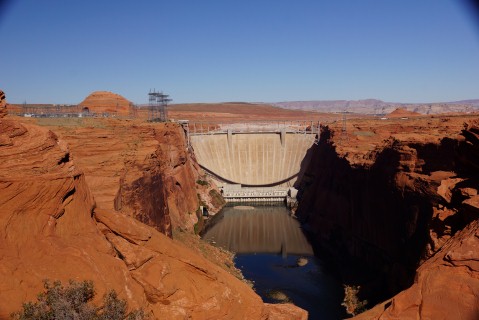
Several minutes after we came back to see what we came for, the dramatic Glen Canyon with the Colorado River below, being held at bay with the enormous Glen Canyon Dam. The small canyon was surrounded by these really interesting layered rock designs in a lush red tone, which made it even more authentic .

Back on hwy 89, retracing our tracks from the day before, we traveled the eighty miles back to Kanab and hung a right still on 89, heading north to hwy 9 to Mt Zion National Park. A few minutes of climbing, we reached the entrance to the park, where we were greeted by a ranger. He told us because it was a public road we could drive through, but under no circumstances could we stop. Along with his stern instructions came a white sheet of paper echoing the same words stamped in bold black ink. I proceeded to drive Dorothy as slow as I could in order to fully take in the incredible colossal terra-cotta mountain range. There is just no decent way to describe the stunning views we encountered. The famous park gave the feeling of intimate closeness within the tight peaks and valleys, but with the most immense mountain ranges I had ever seen.
Twisting and turning slowly descending downward, we were immersed in the most exquisite deep rich cayenne red forest of towering rocks for the next 5 miles, even the road was a beautiful red clay color. By not being able to stop was like giving a child candy and then forbidding him to eat it! It was seriously difficult not to do. Matt took as many photographs as he could out the window. When we exited the park we were able to stop and take a few more.

We continued on for a few more miles to the town of Virgin, where we (and I use the term loosely!) decided to camp with Dorothy for the first time. I actually resisted and was a little relieved when we were finding it difficult to go forward with the original plans to camp because of the parks being closed. I thought this would actually benefit my reluctance to want to camp. But, I was sweet talked into it or maybe it was more like being quilted into it from making Matt wear the tie-dyed shirt I made him! Either way, I consented!
We got a nice spot nestled in the Zion palisades and made a fire and then cozied up for the night in the van. It was actually pretty fun and I would definitely do it again, especially with Matt!
Day 8 – Turning Another Page

One of the really cool things about being on this road trip (among many) is the variety of interesting people you meet from all over the world. When we were staying at the The View, in Monument Valley, we met a retired German gentleman. He and his wife had shipped their camper over from Germany six months ago to tour the states for a year. Matt and I thought that was just amazing story. He had suggested to us that we go to Glen Canyon in Page Arizona if we couldn’t get into the Grand Canyon. He went on to say he found it more interesting because it was smaller and you could see more of the unique deep, broad curvatures of the canyons.
After our disappointment with trying to enter the park, we decided to take the Germans’ advice and head for Page Arizona in search for a pseudo Grand Canyon. Starting from Marble Canyon, this meant going up and around the Vermillion Cliffs in an almost two-hundred mile detour.

We coaxed Dorothy up to 8,000 ft to Jacob Lake, she was not happy about it! Making the climb the scenery changed again from scattered tuffs of cactus to tall slender pine trees, very reminiscent of Lake Tahoe. Passing another closure sign for the north ridge entrance of the Grand Canyon, we finally spotted another VW bus, which looked to be a late 70’s Westy. Matt and I almost came out of our seats with excitement, waving out the window and honking at them at the surprising sight of a fellow vintage VW owner. We must have laughed about it for a mile or more.
Making our descent into Fredonia AZ, we stopped to gas Dorothy up. It was a combination Chevron gas station with a deli. I noticed a car pull up stop take a picture and then drive off. I looked over my shoulder to see the hand-painted sign over the store saying “Lotto, Guns & Amo”. I don’t know about you, but I don’t see that too much where I come from!

We, hung a right on to hwy 89 after crossing the border into Utah. Eight miles or so and another state line crossing, we arrived in Page, AZ. Matt and I were growing more and more frustrated with every National park entrance we passed blocked off; Jacob Lake, closed, north rim, closed, Lake Powell, closed, Wahweap, closed and Glen Canyon closed!
By the time we reached the Glen Canyon dam, just outside of Page, we were tired, it was late and we now felt like is was total waste of time coming all the way out. We sat on the edge of Dorothy’s sliding side door and made an executive decision to stay the night in Page and try to make the best of it. We took our chances again on a Travel Lodge, grabbing one of the last remaining rooms because of the influx in diverted park visitors.
We walked up to the Page Steak house and treated ourselves to a drink and an over priced meal! The price of fuel and food was definitely on the rise from being spoiled with the lower prices we experienced in the previous states we went through!
In regards to Dorothy and how she is doing; She is running a lot more lean since her visit to Rick’s Automotive in Farmington, AZ. She struggles to warm up in the morning, but seems great out on the road, having noticeably more power climbing the grades. We joke that Dorothy has a drinking problem, soaking up the fuel, oil and brake fluid. I swear, if she had a radiator she would siphon that up too! But, everything is at a minimal (except for the fuel!). We gave her a bath and she didn’t appreciate the gesture because she wouldn’t start! Matt doused her with W-D 40 and that seemed to put her back in a decent mood. It’s funny, we talk about the bus as if it’s a person, but honestly, with all her individual personality traits and daily “mood swings” I feel like we’re dealing with (as Matt would say) a petulant child!”! But, I think she is beginning to know who’s boss!
Day 7 – Dorothy Has a Thing for the Beatles

This morning we were up and ready by 5:00 AM, but this time was purposefully in order to be prepared for the magnificent sunrise that would soon come to light behind the massive statuesque crags.
Matt and I sat in the lobby waiting for a few minutes until we started to see the sun begin to peek its head up. We ran out to the overlook where we were the night before, shooting the same scene in the setting sun. I was surprised to find several other people out as well. But then thinking about it, why wouldn’t they?
It was absolutely freezing out to the point where I started to lose the feel in my finger tips. It was an unexpected temperature change from the past week wearing shorts and t-shirt. It must have dropped 30 degrees from the day before! We hung on for as long as we could, enduring the unfamiliar frigid atmosphere until we were satisfied with our photographs.

We fired up Dorothy around lunch time with no issue other than her stalling a few times before she was completely warmed up. Matt and I are convinced she is an attention seeker, always wanting to be dotted on first thing every morning. We gladly accepted the minimal demand and made our way back to Kayenta and west on hwy 160 hoping to get into the Grand Canyon, a hundred or so miles away.
Driving a vintage VW bus is not like driving a modern car. We found ourselves envying other drivers with advanced technology cars…like power steering, power brakes, and air conditioning! If one of us was only able to drive the long trek, it would have been a major problem, because of the concentration and strength to maneuver her around. She is exhausting!
 It was my turn to drive and we decided to play the 60’s & 70’s play list on my iPod I had downloaded for the trip. I made a compilation of the Young Bloods, The Guess Who, Beatles, Santana and others. There were approximately 72 songs on the play list. On shuffle, the first song that came on was Get Back by The Beatles, second song, Strawberry Fields Forever, The Beatles. This went on for 4 or 5 songs. Matt and I both looked at each other and started to laugh, convinced Dorothy was controlling the music selection on the stereo. Dorothy almost exclusively played every Beatles song on the list before any of the other songs played…..hmmm?
Later I was thinking about it, 1970 was the year Dorothy was born and it was also the same year the Beatles broke up…..Coincidence? I don’t know, you be the judge!

Twenty miles into our journey, the scenery slowly morphed from a beautiful silhouette of mountain ranges into more of a desert landscape. At a steady 5,000 ft, we started to climb another 1000 ft before reaching the Desert View entrance to the Grand Canyon. Earlier, we had been informed by several different people that the Northwest entrance was run by the Indian Nation and that it might be possible to enter the park.
We arrived to find a park closure sign. Disappointed, we retraced our tracks back up 89A , passing our original turn from 160 and up into Echo Canyon. What an incredible massive display of sienna stained cliffs that seems to go on forever. It made little Dorothy seem infinity small in comparison. With some of the most gorgeous backdrops this country has to offer, both Matt and I found it interesting that the towns and scattered dwellings appeared to be owned by communities with little to no revenue. The small run-down town of Tuba, AZ was filled with beat-up mobile homes perched on dirt lots. It was difficult to imagine what life would be like living there.
Passing the scattered small rectangular shaped fabricated homes, we noticed spare tires as a commonality on the roofs. We could only surmise that it was a local economical technique in preserving their shelter from the harsh seasons from the desert.

Unexpectedly, we had to travel another 13 miles off course because of a road closure at the gap on 89, due to a landslide last winter. Twenty minutes later we pulled into a Chevron station at Marble Canyon. A dot of a little town, if you want to call it that. There was a hotel there, so we both thought it best to stay for the night. I had to go into the gas station in order to book a room, very strange..
We were literally in the middle of nowhere, engulfed by the most spectacular cayenne colored cliffs I had ever seen! This also was where Lee Ferry & Glen Canyon National Park entrance, which was directly beside the Navajo Bridges. Two magnificent bridges (pedestrians and motor vehicles) that overlooks a gigantic gorge to the Colorado River below.
After checking in and unloading our gear into the hotel room, we took a walk down to Marble Canyon to take pictures of the awesome views. We noticed a large gravel parking lot full of what looked to be a make-shift campsite. We thought it strange but carried on walking until the penny dropped after seeing the big red sign that read “ Glen Canyon closed after a lack of appropriations”.

We learned early the next morning after hearing some of the campers talking with other travelers in the local cafe how there was a combination of rafting and hiking groups that were stranded because of the government closure of the National Parks. We heard a young guy telling this couple about how he knew of people in his group that had been planning their trip for over a year. He also went on to explain, because the group organizers had planned out meals based on the daily stops while on the trip, the guests were having to ration out their own food supplies as a result of being stuck in a parking lot.
We had talked to a few people from the hiking group that had planned to stay a few days in Marble Canyon and then head into the Grand Canyon, but those plans were obviously squashed because of the National Park closures as well.

In the beginning, the closures had only inconvenienced us with our plans to visit the Grand Canyon, but now we were starting to get worried hearing all the sad tales of other people’s disappointing experiences. We were excited about visiting Zion National Park, but we now had to start rethinking that idea and the rest of our trip…..
 Motoette -in forward motion